
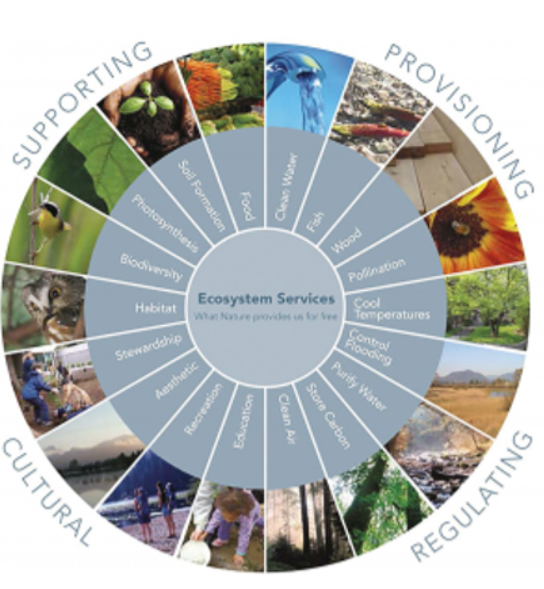
Ecosystem services are the benefits people obtain from the ecosystem (MEA 2005).
As an integral part of the terrestrial ecosystem, soils play a crucial role in the provision of a myriad of so-called soil ecosystem services.
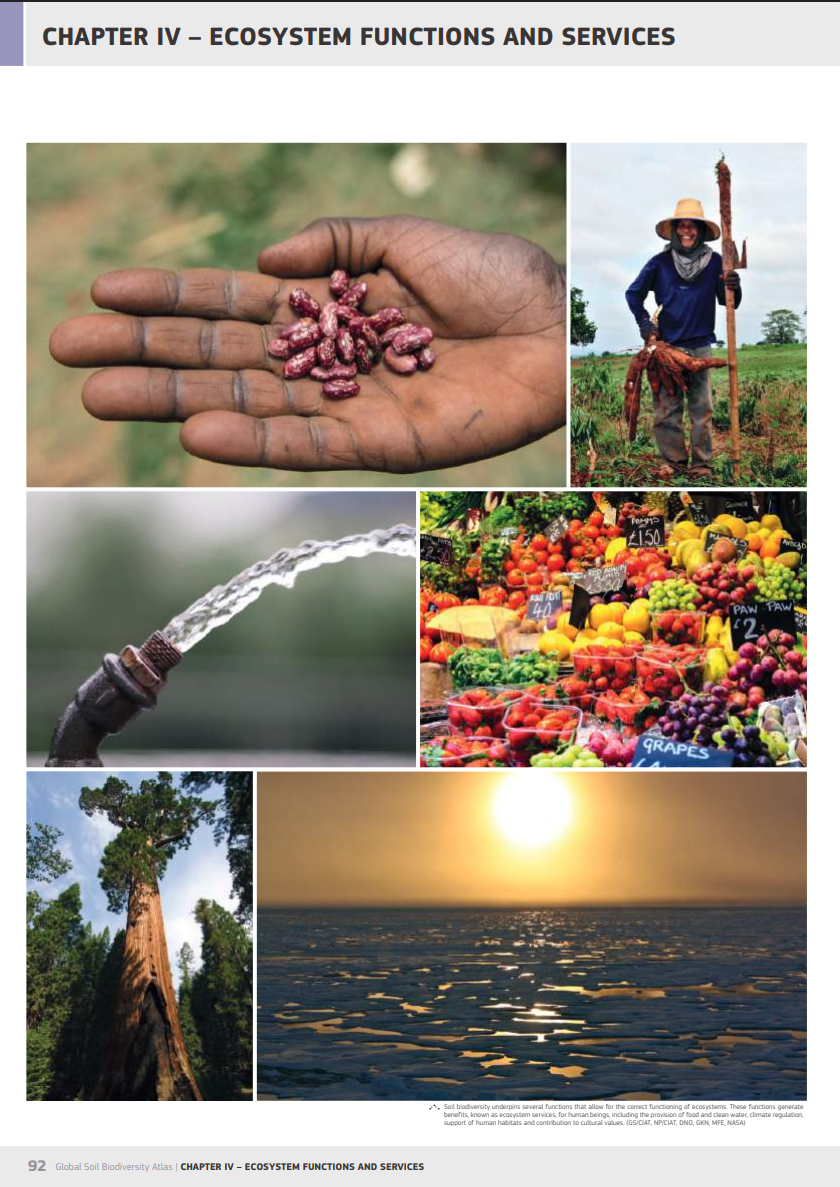
Soil is the basis of Alpine ecosystems; it is a fundamental natural resource especially in the vulnerable Alpine Region.
Through the sustainable management and protection of soil, we enhance the sustainable management of the Alpine environment, considerably contribute to the performance and resilience of key ecosystem services, preserve biodiversity, and ensure the well-being of humans.

Soil management and protection is provided for in the framework of the Soil Conservation Protocol of the Alpine Convention, which is aimed at safeguarding the multifunctional role of soil based on the concept of sustainable development.
The provision of soil ecosystem services relies on soil properties, processes and functions. Furthermore, healthy and diverse soils ensure biodiversity among soil biota (soil biodiversity), which in turn guarantees the provision of soil ecosystem services.
Soil ecosystem services are vital components to all aspects of life and they support the production of ecosystem goods and services, such as:
- Food, fibre, and energy provision,
- Water storage and purification,
- Neutralization, filtering and buffering of pollutants,
- Natural hazard regulation,
- Climate regulation,
- Archive natural and cultural phenomena.
Since soil ecosystem services are based on Soil Functions and Soil Biodiversity, this section also holds further information on those topics. You can read more about ecosystem functions and services in a summary, written by Dr Edmundo Barrios (UN Food & Agriculture Organization). You can also download the Links4Soils booklet:
- https://www.alpinesoils.org/wp-content/uploads/2025/08/2019-0125_SoilEcosystemServicesInBriefISBN-WEB.pdf
- https://www.alpinesoils.org/wp-content/uploads/2025/08/2019-1025_SoilEcosystemServicesInTheAlps-WEB.pdf
SES logos
Below is a description of the SES logos (created during the Links4Soils project).
 Agricultural biomass production
Click / Tap to flip
Agricultural biomass production
Click / Tap to flip
The different horizons and the soil profile indicate the properties of fertile soil suitable for growing a variety of crops for food: the diversity and quality of food are indicated by the grain and apple.
 Forest biomass production
Click / Tap to flip
Forest biomass production
Click / Tap to flip
The logo links soil properties, aboveground forest biodiversity, and forest production – timber needed for construction, various everyday products (e.g. furniture), as well as firewood for green energy.
 Water retention
Click / Tap to flip
Water retention
Click / Tap to flip
The drop of water lying in the middle of the soil horizons indicates the ability of soils to capture, store, and gradually release water for plants and soil biota as well as for evaporation from the soil surface.
 Nutrient cycle regulation
Click / Tap to flip
Nutrient cycle regulation
Click / Tap to flip
Macro and micro plant nutrients (N, P, K, Ca, Mg, and many others) are present in soil due to the microbial fixation of nitrogen, weathering and transformation of primary minerals. Without soil’s capacity to retain, exchange, and cycle nutrients in situ, soil fertility would decrease and be significantly reduced. Nutrient regulation and cycling ensures long-term soil fertility and, thereby, the vegetation cover, consisting of wild or cultivated plants.
 Soil habitat and biodiversity
Click / Tap to flip
Soil habitat and biodiversity
Click / Tap to flip
The different types and thicknesses of the horizons in the soil profile indicate a physical and very special place rich in soil biota. A myriad of very different organisms live in every handful of soil. The extreme diversity of life forms in soil largely exceeds the aboveground biodiversity. The so-called soil ‘gene pool’ is a source of useful products, e.g. medicines.
 Cultural and natural archives
Click / Tap to flip
Cultural and natural archives
Click / Tap to flip
This amphora buried in soil represents cultural artefacts and other remains of ancient civilizations. Hidden, protected, and conserved by soil, artefacts are preserved for modern civilization. The ammonite represents the natural heritage, which in the case of soils, comprises several specific, rare, and well-expressed soil morphological features. Special formations and patterns of horizons, colours, and specific horizons need protection in a similar way as geological features.
 Surface runoff regulation
Click / Tap to flip
Surface runoff regulation
Click / Tap to flip
The three drops percolating through the soil horizons indicate how soil largely absorbs rain, snow melt, or flooding waters and therefore reduces surface runoff through infiltration. The drops to the groundwater indicate an additional benefit: groundwater recharge.
 Local climate regulation (“the cooling effect”)
Click / Tap to flip
Local climate regulation (“the cooling effect”)
Click / Tap to flip
The logo presents evaporation from the soil surface and indicates the transpiration of plants. Both processes are joined into evapotranspiration, which cools the surface of soils and plants and thus reduces the temperature resulting the meso- and microclimate.
 Recreational and spiritual services
Click / Tap to flip
Recreational and spiritual services
Click / Tap to flip
The logo unites humans and different soil properties that determine soil potentials and land uses and largely define natural and cultural landscapes. In an important way, specific soil capacities (starting with depth, water holding capacity, fertility, etc.) define land suitability and contribute to scenic landscapes and natural beauty in relation to a variety of recreational activities, sports, and spiritual benefits.
 Water filtration and purification
Click / Tap to flip
Water filtration and purification
Click / Tap to flip
The indicated soil horizons have different capacitates to filter percolating precipitation and flood waters, to neutralize and degrade harmful substances, and to enrich the water with minerals. Water cleaned on its way through the soil profile becomes potable groundwater.
 Global climate regulation (“the carbon cycle”)
Click / Tap to flip
Global climate regulation (“the carbon cycle”)
Click / Tap to flip
The logo explains different soil properties – different horizons that to a large extent define the capacity to store, exchange, and cycle carbon (C). C available in the atmosphere as CO2, a greenhouse gas, cycles through plants to the topsoil, where it comprises soil organic matter – humus and soil organisms. When organic matter is mineralized by microorganisms, the C is returned back to the atmosphere.